
The two faces of investor reporting
“Investor reporting” describes two distinct workflows that share more mechanics than people expect.
Founder-to-investor reporting is the monthly or quarterly update a founder sends to angels, seed and Series-A investors. Narrative-heavy, metrics-supported, often informal. The audience reads it in five minutes between meetings; the goal is to keep investors informed and to surface asks where they can help.
GP-to-LP reporting is the formal quarterly report a fund sends to its limited partners. Highly structured, regulated by side letter and by ILPA reporting standards in many cases, with required line items: NAV, capital calls, distributions, fund-level performance, portfolio company commentary. The audience reads it carefully; the goal is to satisfy reporting obligations and to demonstrate stewardship.
Different audiences, different obligations, but the same underlying problem: a recurring deliverable that has to bind to data living in several systems and arrive on a schedule. Both run cleanly on the four-component architecture from the document automation guide.
Metrics · Google Sheets
Template: Google Slides or Docs
{{company.name}}
Investor update · {{period}}
{{metrics.mrr}} MRR
{{metrics.churn}} churn
{{narrative.highlights}}
generated monthly; numbers pulled from the sheet
Generated output
DocsPDFAcme Labs
Investor update · March
$86,400 MRR
1.8% churn
Two enterprise pilots converted this month.
What investors actually want to see
Across both audiences, the patterns of what gets read versus skimmed are surprisingly consistent.
| Founders writing to investors | GPs writing to LPs | |
|---|---|---|
| Read first | The headline number this month, in context; do not bury it on slide six | NAV and performance: gross and net IRR, TVPI, DPI |
| Then | What changed: trajectory, not snapshot | Capital activity: calls and distributions, with rationale |
| Wins | Two or three lines each, only the ones that mattered | Portfolio summary: per-company commentary as a thesis check |
| Bad news | Risks and lowlights; hiding them loses trust faster than naming them | Fund-level narrative: deployment pace, what the GP is seeing |
| Close | One or two specific asks; “let us know if you have thoughts” gets ignored | Compliance and operational items: disclosures, audit status, admin notes |
A working investor update template
The healthy founder update is roughly two pages or six slides, structured around five sections: headline, metrics, wins, lowlights and risks, asks. Build that template once, in your tool of choice, and the structure becomes the framework an automation layer can fill. The investor update template is that structure written out in full, with two worked examples and the KPI block, as a Google Doc you can generate against.
The healthy LP report is more structured: a fund cover, a performance summary, a capital activity statement, a portfolio company section (one block per company), and a fund commentary section. The template gets longer and the data layer gets harder, but the mechanics are the same.
For founders running on Google Docs or Slides, an automation layer can pre-fill the data sections and leave the narrative blocks marked for the founder to write. For GPs running on InDesign or Word, the template is more rigid and the automation is more comprehensive.
The data layer: Stripe, QuickBooks, fund admin
The data layer is where investor update automation actually pays for itself.
| Number | Founders pull it from | GPs pull it from |
|---|---|---|
| Revenue and fund performance | Stripe, Chargebee, the billing system, Excel early on | Fund admin: Carta, Allvue, Anduin, Aduro, in-house accounting |
| Cash, expenses, capital | QuickBooks, Xero, NetSuite, the accounting tool’s API | The GP-side ledger of contributions, distributions, expenses |
| Product and portfolio metrics | Mixpanel, Amplitude, the warehouse | AngelList, Carta Cap Table, the portfolio tracker |
| People | HRIS or a spreadsheet | Portfolio company reporting |
The bind is direct: the system pulls these on the day the update is generated, calculates the metrics the way you’ve defined them, and renders them into the template. The founder edits the narrative; the data is fresh.
GPs’ data layer is harder because the data lives in fund admin tools that are conservative about API access. The pragmatic pattern: pull what’s bindable directly, fall back to scheduled spreadsheet exports for the rest, treat both as data sources for the same generation engine.
From template to automation
The signal that you’ve outgrown a template-only workflow:
- Pulling the metrics each cycle takes more than two hours
- Last cycle's numbers were wrong because someone refreshed the wrong source
- Updates ship late more than once a quarter
- You are a GP producing more than ten LP-specific report variants
- You are a founder sending three versions of the update to three audiences
Two or more ticked: the data assembly is the cost, and it is the part automation removes.
Automation removes the data-assembly cost. It does not remove the founder’s narrative or the GP’s commentary; those are the parts of the update that should not be automated.
How to automate quarterly fund updates
The quarterly LP report is the founder update at fund scale: more recipients, more sensitivity, and a hard deadline. Automating it well comes down to five steps, in this order.
- 01
Put every number in one place before the quarter closes
Fund-level figures from the fund admin export, per-company figures from the portfolio tracker, ownership from the cap-table tool. Land all of it in one base or sheet with a quarter column, so generation reads one source.
- 02
Make the narrative data too
Commentary, highlights and risk notes belong in fields next to the numbers, not in a separate draft. That is what lets one template produce a complete report rather than a shell someone still has to finish.
- 03
One template, filtered per LP
Build the master once, in Google Slides for a designed report or Google Docs for a long-form one. Per-LP sections (commitment, capital account, side-letter terms) are loops and filters over the same data, not separate templates.
- 04
Generate, then review once
A batch run produces every LP's report; a partner reviews the set, not each file. Corrections go into the data and the batch is regenerated, so the fix reaches every copy.
- 05
Distribute from the workflow
Data-room upload or email per LP is the last step of the same pipeline, triggered when the review is approved. The quarterly close becomes a review with a deadline, not a rebuild with one.
The compliance question for GPs
GPs operate under reporting obligations that founders don’t. Side letters with LPs often specify reporting cadence, required line items, and audit trail. ILPA reporting standards apply to many funds. SEC reporting applies in some cases, depending on registration status.
Automation helps compliance more than it threatens it, in our experience: deterministic generation produces consistent reports, the audit trail is complete (which inputs produced which output, when), and the narrative blocks can be reviewed independently of the data blocks. The honest legal question is where the data lives: most funds want their LP reporting data to live in fund-admin systems they already vetted, with the automation layer pulling read-only.
For GPs evaluating this, we recommend designing the automation so that the data layer respects the existing access controls of your fund admin software, the generation engine never sees data outside its scope, and the orchestration layer’s audit trail is comprehensive and exportable for your annual audit.
SourceToDocs for investor reporting
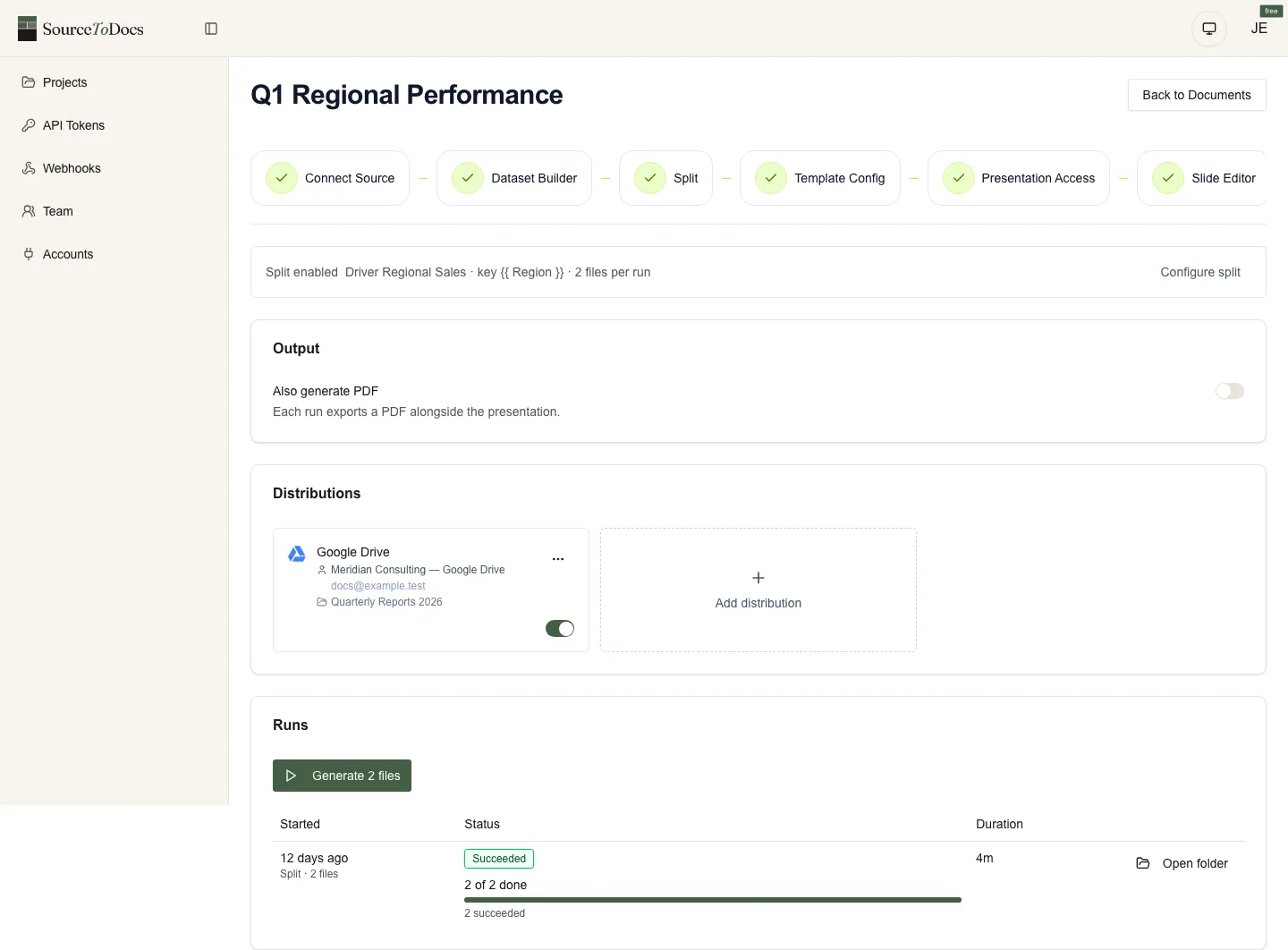
SourceToDocs runs as a template-driven investor update automation platform. The data layer connects to Airtable, Google Sheets, SQL databases, CSV upload, and a REST API — the REST API works with n8n, Make, Zapier, or anything that speaks HTTP, so Stripe, accounting and fund-admin data feed in through those sources. Templates are authored in Google Docs, Slides, PowerPoint or Word by the design team or the IR team. The orchestration layer schedules monthly or quarterly runs, routes outputs to the founder or IR team for narrative editing, and keeps the audit trail your auditor will eventually ask for.
The narrative layer is hybrid: AI-assisted drafting where you want it, human voice where it matters. We discuss this on the AI report generator page. SourceToDocs is a SaaS document automation platform with a free plan and self-serve tiers from $19/mo billed annually (Starter, Pro, Agency, Scale) plus Enterprise. REST API and n8n/Make/Zapier automation from the Pro plan up. See pricing for the full breakdown.