Business proposal template for Google Docs
A client-facing proposal with scope, deliverables and pricing, generated one per opportunity from your deal data.
Free plan, no credit card. Bring your own design or start from this layout.
What’s in this template
Every block is bound to a field in your data. The layout stays exactly as designed; only the values change from one run to the next.
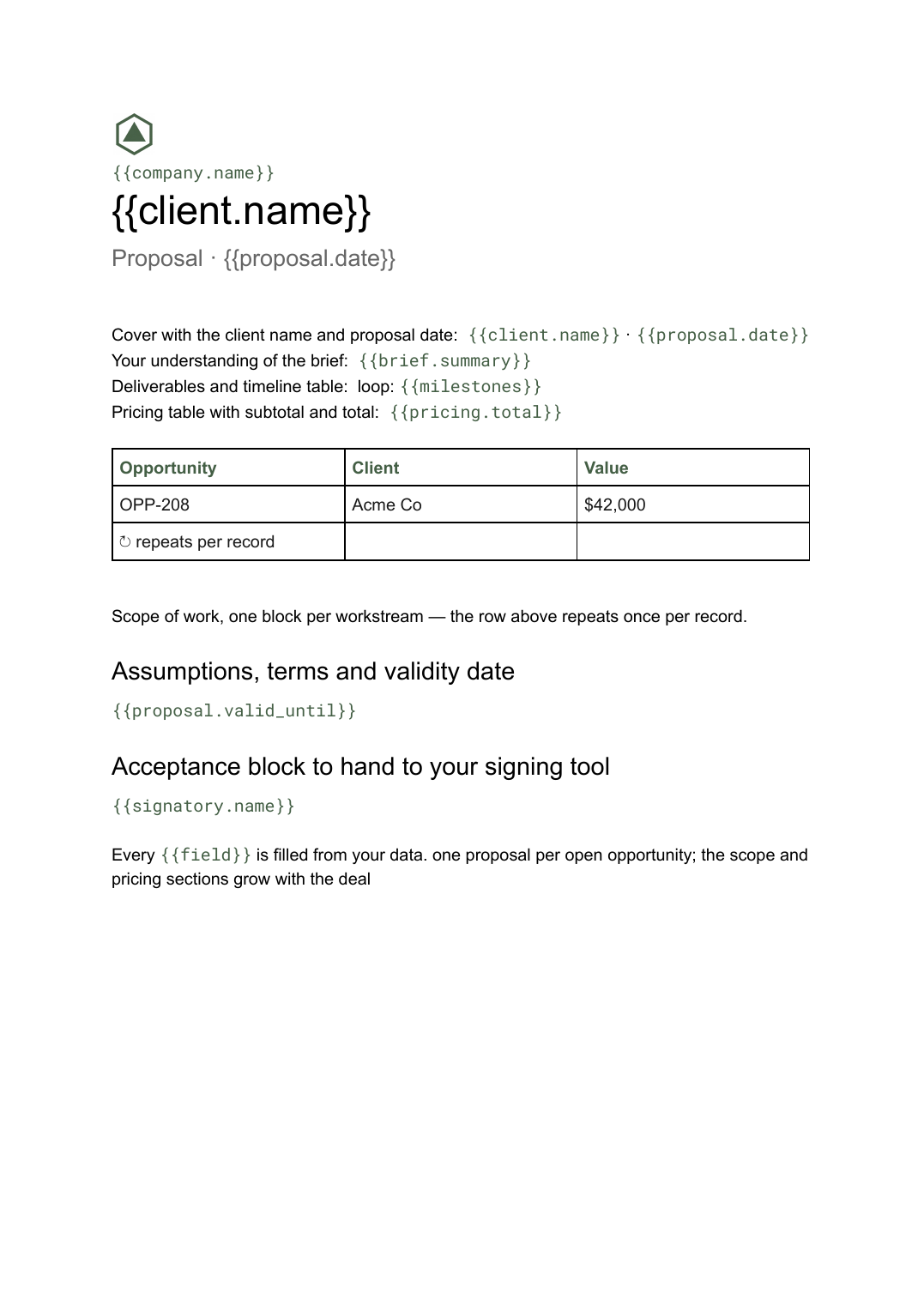
- Cover with the client name and proposal date {{client.name}} · {{proposal.date}}
- Your understanding of the brief {{brief.summary}}
- Scope of work, one block per workstream loop: {{workstreams}}
- Deliverables and timeline table loop: {{milestones}}
- Pricing table with subtotal and total {{pricing.total}}
- Assumptions, terms and validity date {{proposal.valid_until}}
- Acceptance block to hand to your signing tool {{signatory.name}}
How this template fills itself
Connect Airtable, Google Sheets, a SQL database, a CSV or a REST API, map each field to a placeholder, and generate. One run can produce a single document or one per matching record.
Opportunities · CRM via REST API
Template: Google Slides or Docs
{{client.name}}
Proposal · {{proposal.date}}
{{brief.summary}}
loop: {{workstreams}} → section
{{pricing.total}}
one proposal per open opportunity; the scope and pricing sections grow with the deal
Generated output
DocsPDFAcme Co
Proposal · 4 Sep 2026
Rebuild and migrate the booking flow
3 workstreams
$42,000 total
Who uses this template
Agencies and consultancies
Send a proposal that reflects the scope you actually costed, because it is built from the same record the estimate lives in.
Read the guideSales teams
Turn a qualified opportunity into a full proposal without an account executive assembling one from an old file.
Read the guideFreelancers and small studios
Keep one master proposal and let the client, scope and price change per job instead of maintaining a folder of near-copies.
Read the guideA business proposal is the document where the stakes and the copy-paste risk are highest at the same time. Most of it is your standard approach, terms and credentials; a small part of it is this client, this scope and this price. It is a Google Doc rather than a deck because the variable part is unpredictable in length — a proposal with three workstreams and one with ten need the same template and different numbers of pages.
Keep the numbers where the estimate lives
The pricing table should read from the same record that holds your estimate, not from a figure someone retyped into the document. When it does, the total on the PDF and the value on the opportunity cannot drift, and a change of scope is made once in the data and regenerated rather than corrected in a file that has already been shared. It also makes the awkward parts consistent: validity dates, assumptions and payment terms come from fields instead of from whichever old proposal was duplicated first.
Related templates
All sales & pricing →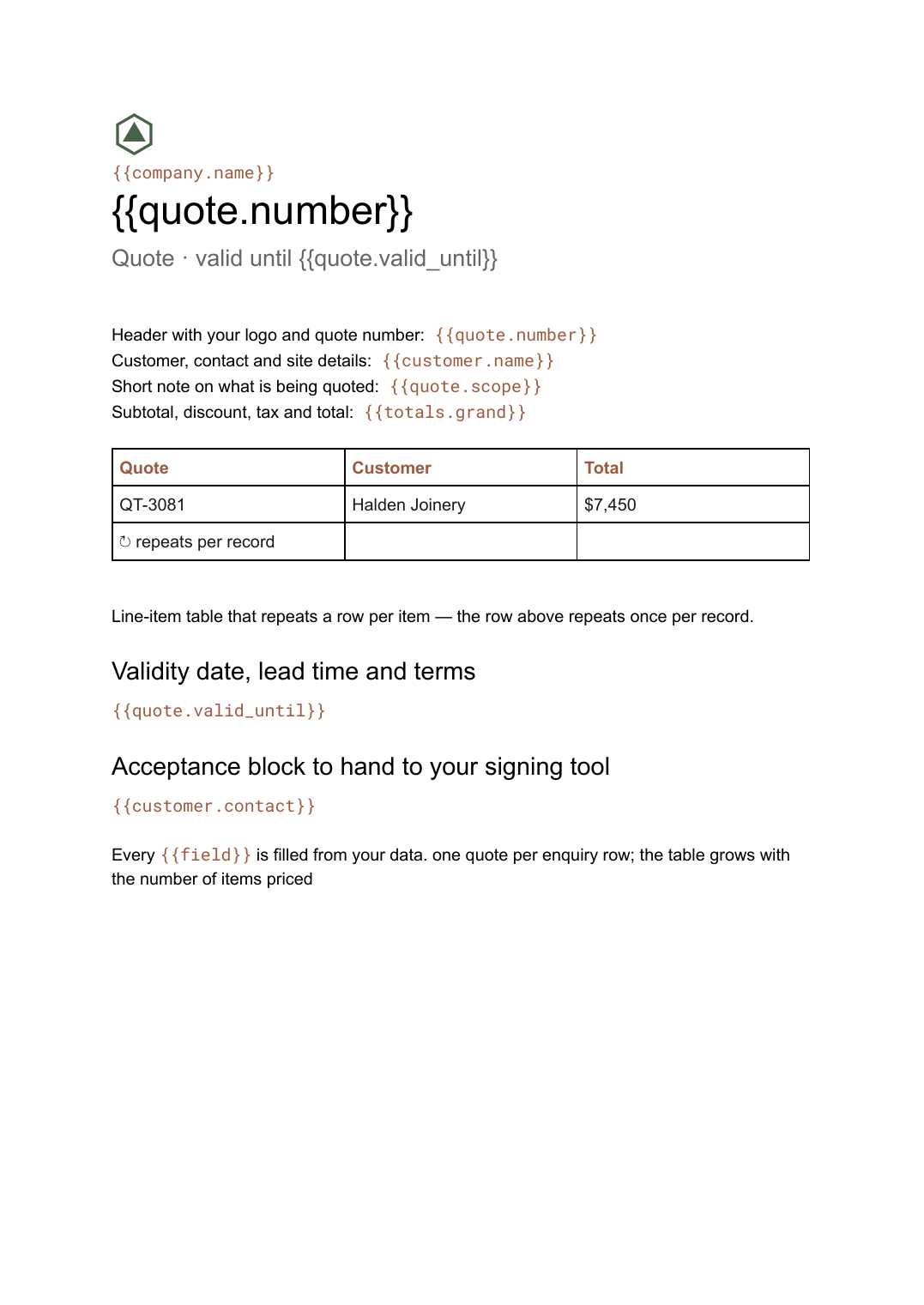 Google Docs
 Quote template
A priced quotation with a line-item table and a validity date, generated one per enquiry from your pricing data.
View template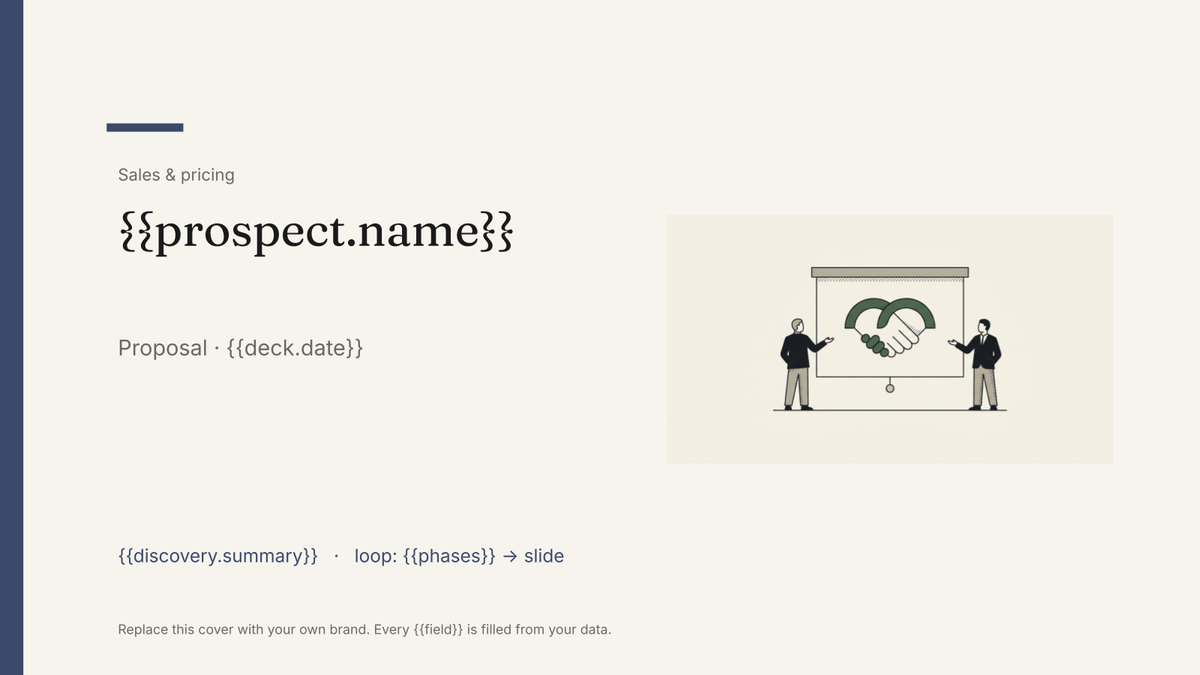 Google Slides
 Sales proposal deck template
A presented sales proposal in deck form, generated one per opportunity from your CRM and pricing data.
View template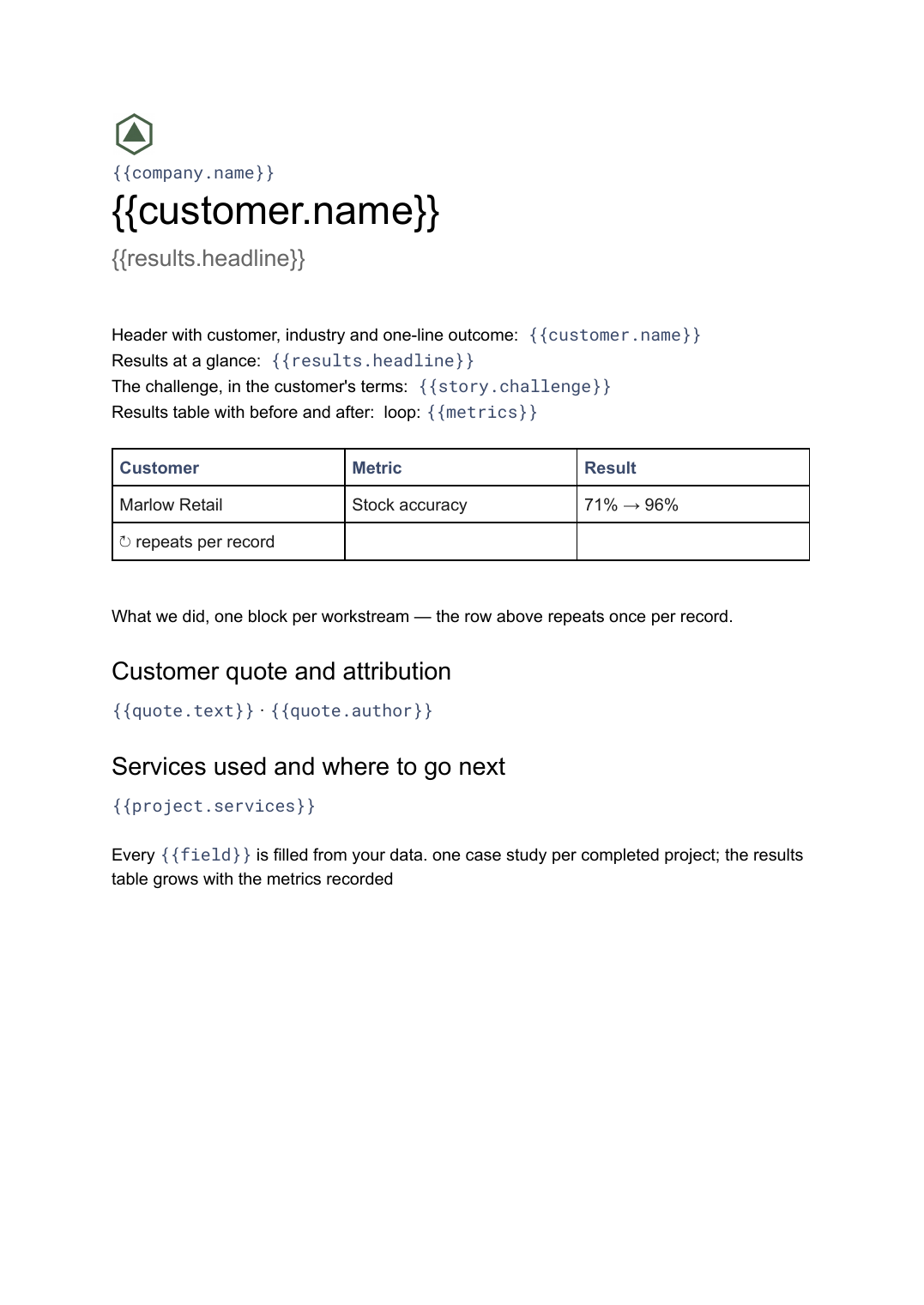 Google Docs
 Case study template
A customer story with challenge, approach and measured results, generated one per project from your delivery data.
View template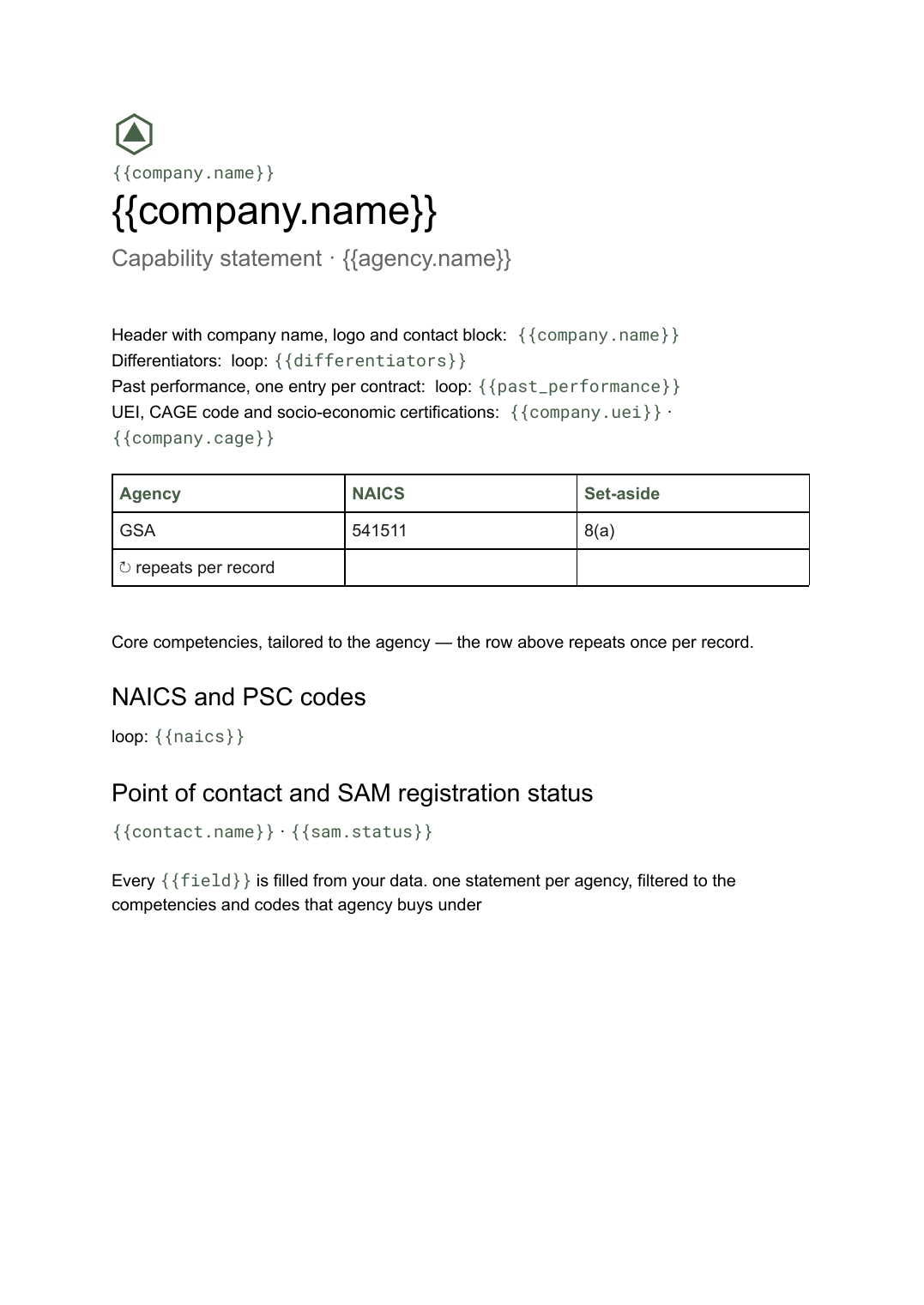 Google Docs
 Capability statement template
A one-page government contracting summary with core competencies, codes and past performance, generated from one company record.
View templateCommon questions, answered
Can I use my own proposal design? +
Can the proposal be signed? +
Where do the scope and pricing come from? +
Can I generate a proposal for every open deal at once? +
Generate this document from your data
Start on the free plan, connect a data source, and export a real Google Docs document. No watermark, no credit card.