Pitch deck template for Google Slides
An investor pitch deck whose metric and traction slides are filled from your live numbers rather than retyped.
Free plan, no credit card. Bring your own design or start from this layout.
What’s in this template
Every block is bound to a field in your data. The layout stays exactly as designed; only the values change from one run to the next.
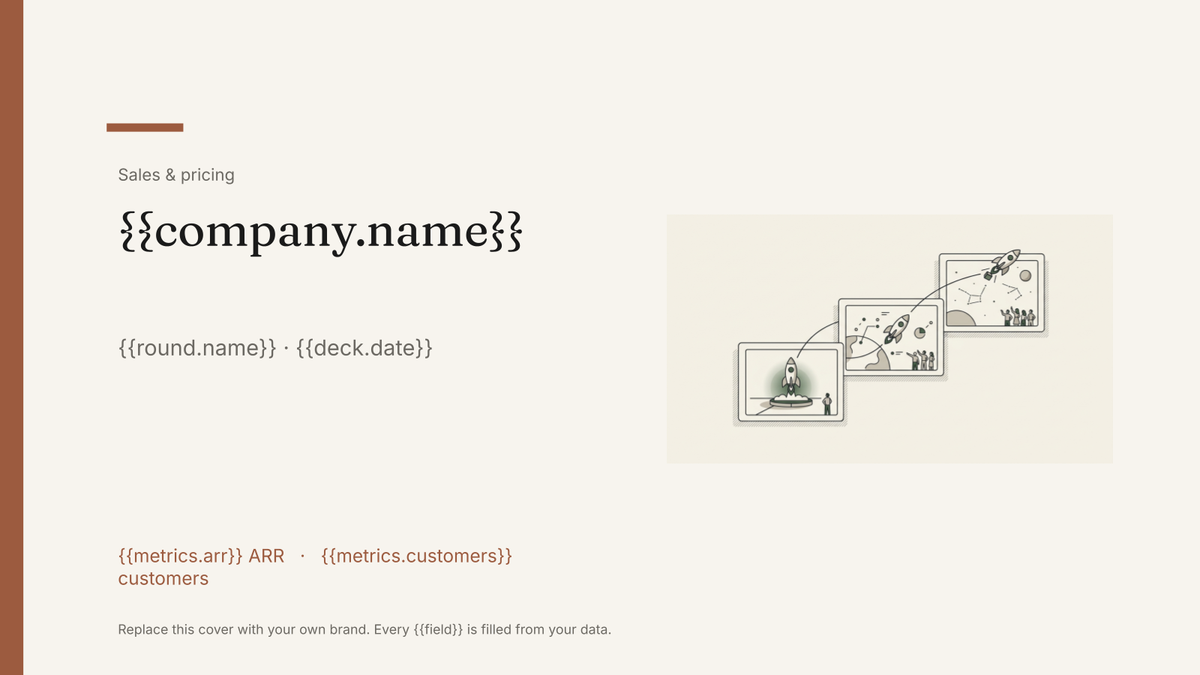
- Cover with company, round and date {{company.name}} · {{round.name}}
- Problem and solution {{story.problem}}
- Market size and where you play {{market.tam}}
- Traction metrics bound to live numbers {{metrics.arr}} · {{metrics.growth}}
- Customer logos and proof points loop: {{customers}}
- Team slide, one tile per person loop: {{team}}
- The ask and use of funds {{round.ask}}
How this template fills itself
Connect Airtable, Google Sheets, a SQL database, a CSV or a REST API, map each field to a placeholder, and generate. One run can produce a single document or one per matching record.
Metrics · SQL database
Template: Google Slides or Docs
{{company.name}}
{{round.name}} · {{deck.date}}
{{metrics.arr}} ARR
{{metrics.customers}} customers
loop: {{team}} → tile
the deck rebuilds against the latest month's row, so no figure is retyped
Generated output
SlidesPDFNorthwind Labs
Seed round · 4 Sep 2026
$1.42M ARR
318 customers
4 team tiles
Who uses this template
Founders raising a round
Refresh the traction slides against this month's numbers instead of editing figures by hand before every meeting.
Read the guideStartup finance and ops
Keep one deck whose metrics come from the same source the board pack uses, so the two never disagree.
Read the guideAccelerators and venture studios
Give a cohort one designed deck and generate each company's version from its own metrics table.
Read the guideA pitch deck is mostly argument and partly arithmetic, and the arithmetic is what embarrasses you. Numbers on the traction slide age from the day they are typed, and the deck sent on Friday rarely matches the one shown on Tuesday. Google Slides is the right home for it because the deck is a designed object with a fixed order and fixed layout — you want the figures to change between runs and nothing else to.
Automate the slides that go stale, not the story
Mark only the volatile parts as placeholders: ARR, growth rate, customer count, logo wall, headcount, the ask. Leave the problem, solution and market slides as written copy, because those are yours to argue and they do not change weekly. Then point the deck at the same table your board pack and investor update read from, so the three cannot contradict each other. A scheduled run means the current deck is always the one on file, and the only question before a meeting is whether the story still holds.
Related templates
All sales & pricing →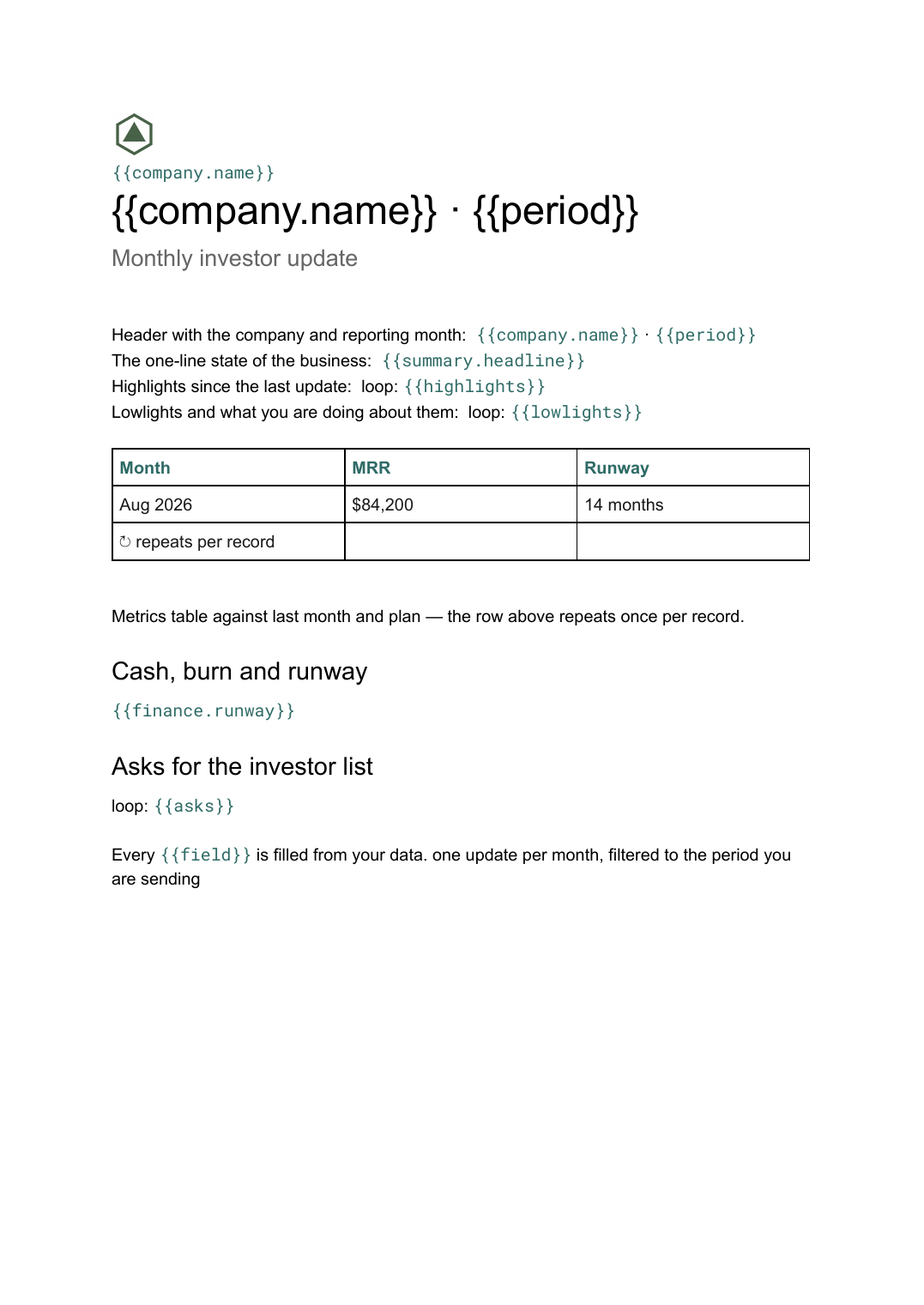 Google Docs
 Investor update template
A founder's monthly written update to angels and VCs covering metrics, progress and asks, generated per reporting period from your data.
View template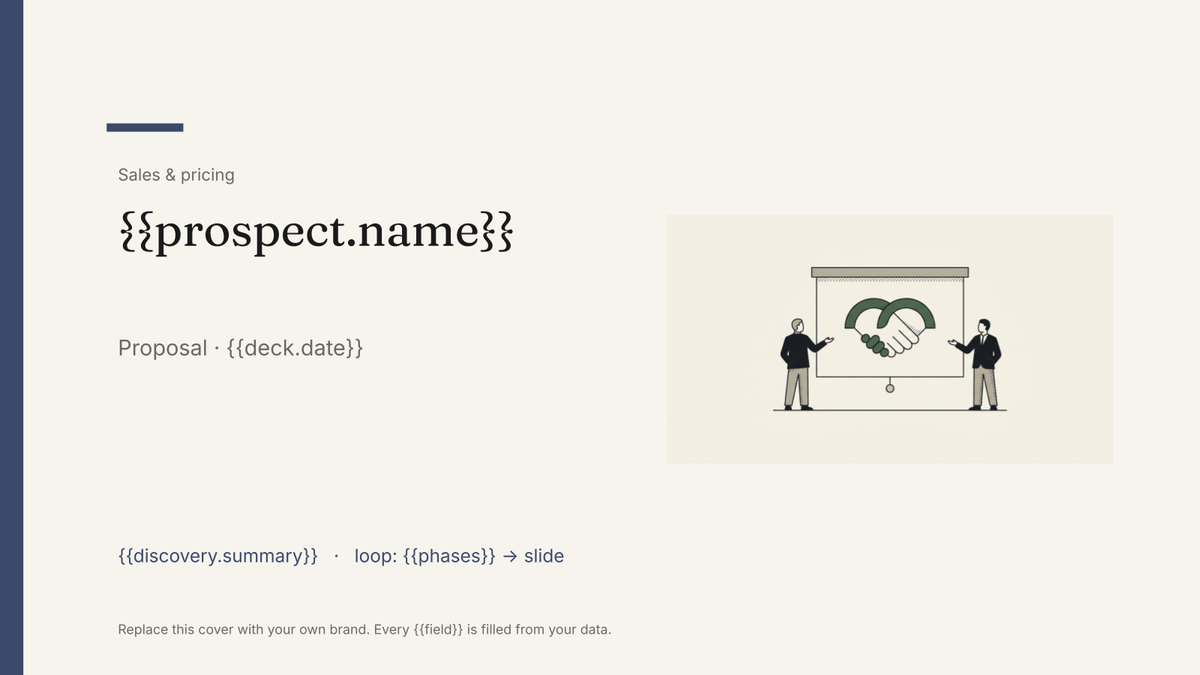 Google Slides
 Sales proposal deck template
A presented sales proposal in deck form, generated one per opportunity from your CRM and pricing data.
View template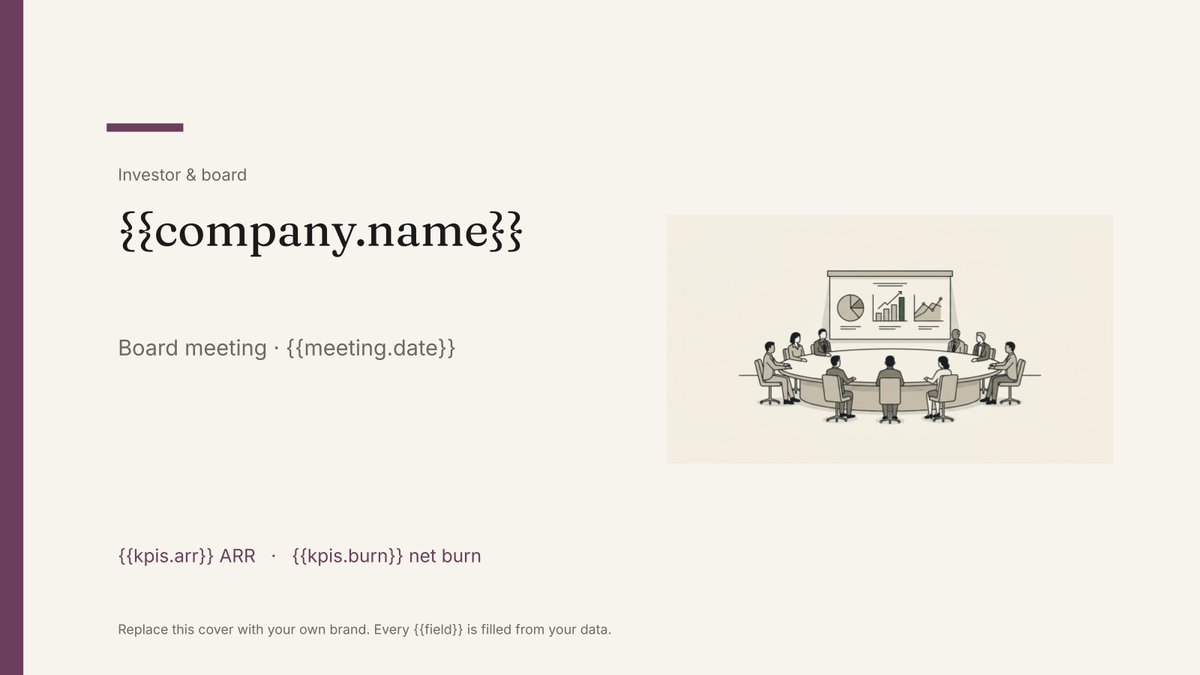 Google Slides
 Board deck template
The presented version of the board pack, built in Google Slides and generated each cycle from your KPI and financial data.
View template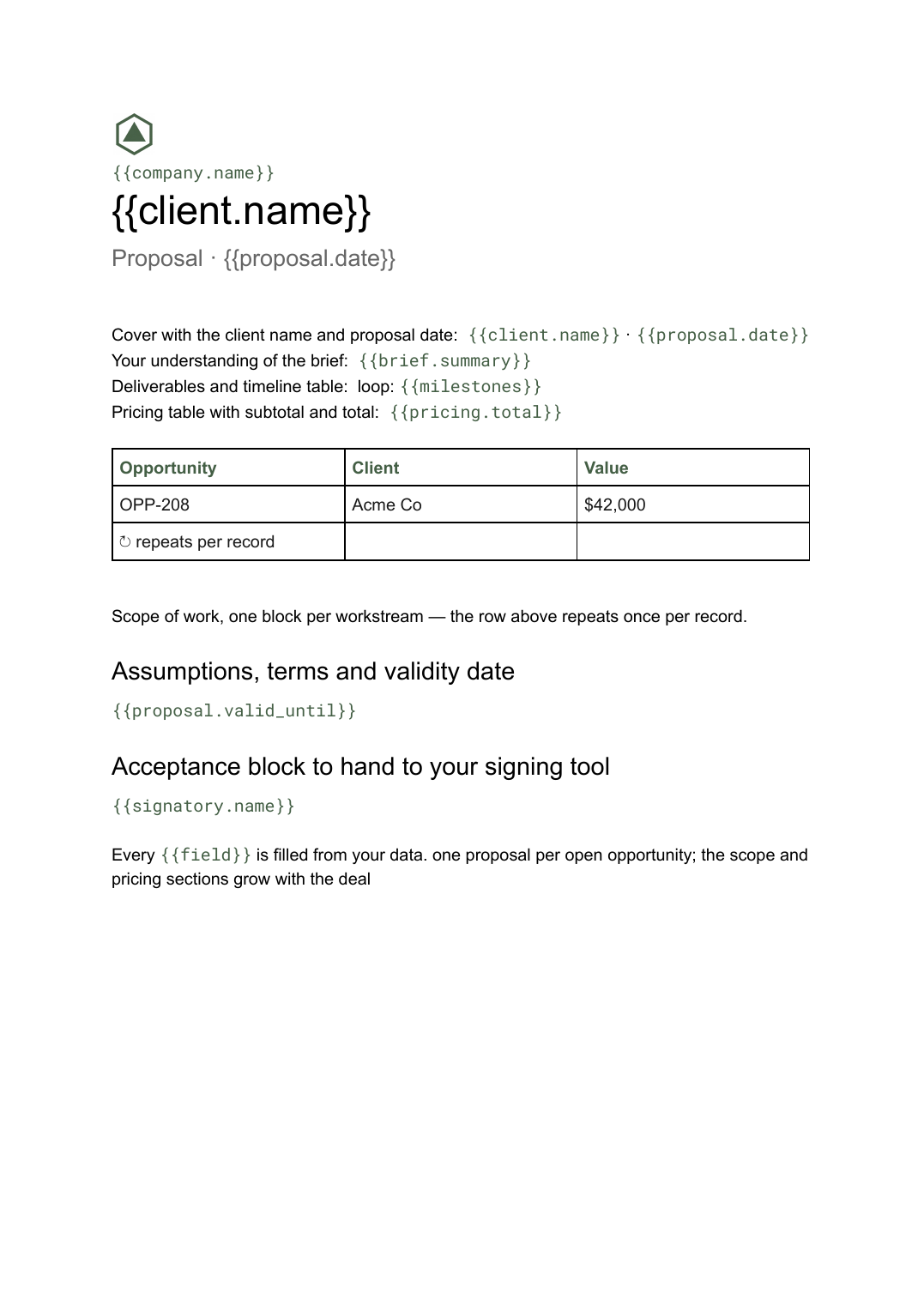 Google Docs
 Business proposal template for Google Docs
A client-facing proposal with scope, deliverables and pricing, generated one per opportunity from your deal data.
View templateCommon questions, answered
Can I use my own pitch deck design? +
Isn't a pitch deck too bespoke to automate? +
Where do the traction numbers come from? +
Can this generate a deck per company or per investor? +
Generate this document from your data
Start on the free plan, connect a data source, and export a real Google Slides document. No watermark, no credit card.